


The Beginner’s Map to Edible Wild Plants for Beginners: Identify, Harvest & Stay Safe
Learning edible wild plants for beginners doesn’t have to feel overwhelming. In fact, once you know what to look for, the world around you transforms into a living pantry filled with safe, familiar plants you can confidently identify and harvest. This guide blends practical foraging wisdom with clear pattern-based learning, helping complete beginners recognize edible plants, avoid dangerous lookalikes, and build a safe, enjoyable foraging routine from day one.
Image: Edible Wild Plants (Alt: beginner identifying edible wild plants for beginners)
(Placeholder – you can replace images on your site)
Why Learning Edible Wild Plants for Beginners Feels Intimidating at First
The Fear Behind Plant Misidentification
Most new foragers share the same quiet worry: What if I pick the wrong plant? That fear is natural. Humans evolved to be cautious around unknown vegetation. When you’re just beginning, uncertainty feels like a warning signal. But with clear structures and repetition, that fear becomes confidence.
Information Overload Is the Real Problem
Trying to memorize dozens of plants rarely works. Beginners need simplicity, not encyclopedias. When you start with just a small number of easy edible wild plants, your brain develops the recognition patterns needed to tackle more advanced species later.
How Your Brain Learns Plant Identification
Your mind learns best through:
-
Seeing the same plant repeatedly
-
Comparing similar species
-
Grouping traits like leaf shape, stem texture, and habitat
This guide uses all three methods to help beginners build reliable identification skills.
Image: Field Guide and Foraging Tools (Alt: beginner foraging tools for edible wild plants)
The 12 Best Edible Wild Plants for Beginners to Learn First
These species were chosen because they’re easy to identify, widely available, low-risk, and extremely beginner-friendly.
1. Dandelion
One of the safest starter plants. Its yellow blooms, jagged leaves, and hollow stems make it unmistakable.
2. Plantain
Broad or narrow leaves with strong parallel veins. Found in yards, trails, and sidewalk cracks.
3. Chickweed
Identified by its small star-shaped flowers and the thin line of hairs running along the stem.
4. Clover
Three rounded leaves with pale markings. Common and edible.
5. Wild Onion & Garlic
The scent test is key: if it doesn’t smell like onion or garlic, do not eat it.
6. Wood Sorrel
Heart-shaped leaves with a lemony flavor — a refreshing trail snack.
7. Lamb’s Quarters
Called “wild spinach,” with diamond-shaped leaves dusted in a powdery coating.
8. Cattail
The tall marsh plant with the brown cigar-shaped head; edible parts vary by season.
9. Purslane
A succulent-looking plant with red stems. Be sure it’s not spurge (spurge leaks milky sap).
10. Wild Berries (Rubus & Vaccinium species)
Blackberries, blueberries, raspberry family — safe and common. Avoid white berries, which are often toxic.
11. Stinging Nettle
Cook it or dry it to disable the sting. A nutrient powerhouse.
12. Pine
Its needle bundles help identify it. Avoid yew, which has flat needles and red berries.
Image: Dandelion and Plantain Plants (Alt: common edible wild plants for beginners)
How Beginners Can Build a Safe Foraging Routine
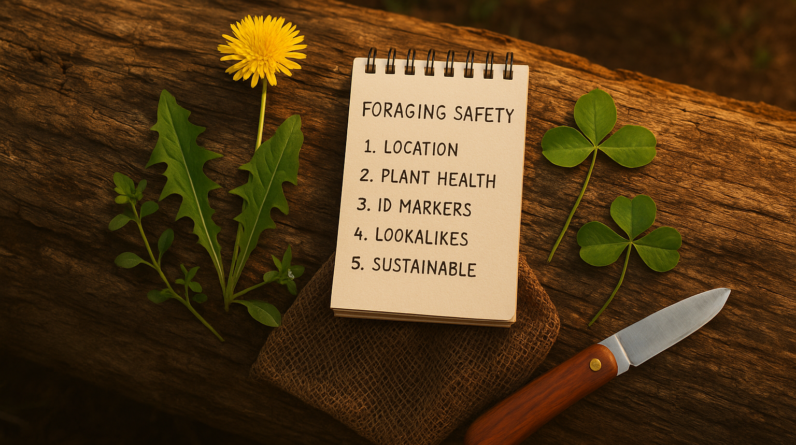
Use This Five-Point Safety Checklist
Before harvesting any plant, confirm:
-
Clean, chemical-free environment
-
Healthy plant appearance
-
Correct leaf, stem, and habitat traits
-
Awareness of lookalikes
-
Sustainable harvesting
For a deeper look at safety, see our internal guide:
➡️ Beginner Foraging Safety Guide
Learn Your Local Rules and Ethics
Parks and nature reserves may restrict harvesting. Always check local laws and practice sustainable foraging.
What Beginners Actually Need to Bring
A small knife, breathable bag, gloves, water, and a notebook. Minimal gear keeps your focus sharp.
Image: Forager Holding Plant ID Book (Alt: identifying edible wild plants while foraging)
How to Prepare and Use Edible Wild Plants
Safe Preparation Methods
Blanching, steaming, sautéing, drying, or simply washing plants can reduce bitterness and protect your stomach.
Why Wild Plants Pack So Much Nutrition
Wild greens contain dense vitamins, minerals, and hydration — ideal for hiking, camping, or survival situations.
➡️ Explore more wild nutrition topics:
Wild Foods for Survival
Common Mistakes Beginners Make
Beginners often rush. Eating a plant without full identification or gathering from polluted areas are the biggest risks. Slow, patient observation prevents nearly every problem.
FAQ About Edible Wild Plants for Beginners
Can beginners learn edible plants quickly?
Yes. When you focus on simple species, learning accelerates fast.
What’s the safest plant to start with?
Dandelion — abundant, obvious, edible from root to flower.
Is urban foraging safe?
Yes, as long as you avoid sprayed lawns, roadsides, and contaminated soil.
➡️ Related: Urban Foraging Tips
Do edible plants have dangerous lookalikes?
Some do, but the differences are clear once you learn them.
Outbound Resources (High-Authority)
✔ https://www.foragingtexas.com/
✔ https://www.fs.fed.us/wildflowers/
Products / Tools / Resources
-
Field Guide: Peterson Field Guide to Edible Wild Plants
-
App: iNaturalist or SEEK
-
Knife: Folding field knife
-
Foraging Bag: Mesh or cloth
-
Notebook: For plant notes and locations


